
Every Indian business owner running payroll on Excel knows the ritual. A master sheet nobody else fully understands. A “final_v3” file that isn’t actually final. A late night before salary day, cross-checking punch cards against formulas that break the moment someone adds a row in the wrong place.
For years, this was simply how it worked — and for a small team, it still can. But as businesses grow past a certain size, the free spreadsheet quietly stops being free. It just moves the cost somewhere less visible: time, errors, and trust.
The real cost of “free” Excel
Excel doesn’t charge a subscription fee, which makes it feel like the cheaper option. But when businesses actually add up what manual attendance and payroll cost them in time and mistakes, a different picture emerges.
| What manual (Excel) attendance actually costs | Approximate figure |
|---|---|
| Annual payroll error rate across mid-market Indian firms | 45–49% of companies report at least one material error a year |
| Typical penalty per statutory violation (PF, ESI, TDS mismatches) | ₹10,000 – ₹1,00,000 |
| All-in monthly cost of “free” Excel payroll for a 30+ employee business (time + errors + audit risk) | ₹15,000 – ₹35,000/month |
| Manual payroll processing cost for a 50-employee company (HR time alone, before errors) | ₹5,500 – ₹9,500/month |
| Typical cost of switching to automated attendance + payroll software | ₹1,500 – ₹3,500/month |
| Typical payback period after switching | 3–6 months |
The pattern across these numbers is simple: Excel isn’t free, it’s just billed differently — in HR hours, in error corrections, and in the occasional statutory penalty that could have been avoided with cleaner records.
The trust gap Excel can’t close
Cost isn’t the only issue. Excel — and paper registers before it — depend entirely on someone entering the truth correctly, every single day, with no way to verify it after the fact.
That gap gets exploited more often than most owners realize. Common patterns industry sources flag repeatedly include:
- Buddy punching — one employee marking attendance for another who isn’t actually present
- Ghost employees — salaries continuing to flow for people who’ve already left
- Proxy attendance — a register marked “present” by someone other than the actual worker, sometimes for a small bribe to whoever’s controlling the sign-in sheet
None of this shows up as a dramatic, single failure. It shows up as a slow, steady leak — some estimates put payroll fraud in Indian SMEs at 3–8% of monthly payroll, quietly, without anyone being able to point to exactly where it’s happening. Excel has no mechanism to catch any of it, because it has no way to verify that the person entering “present” is telling the truth.
Where Excel breaks down hardest: multi-location, shift-based teams
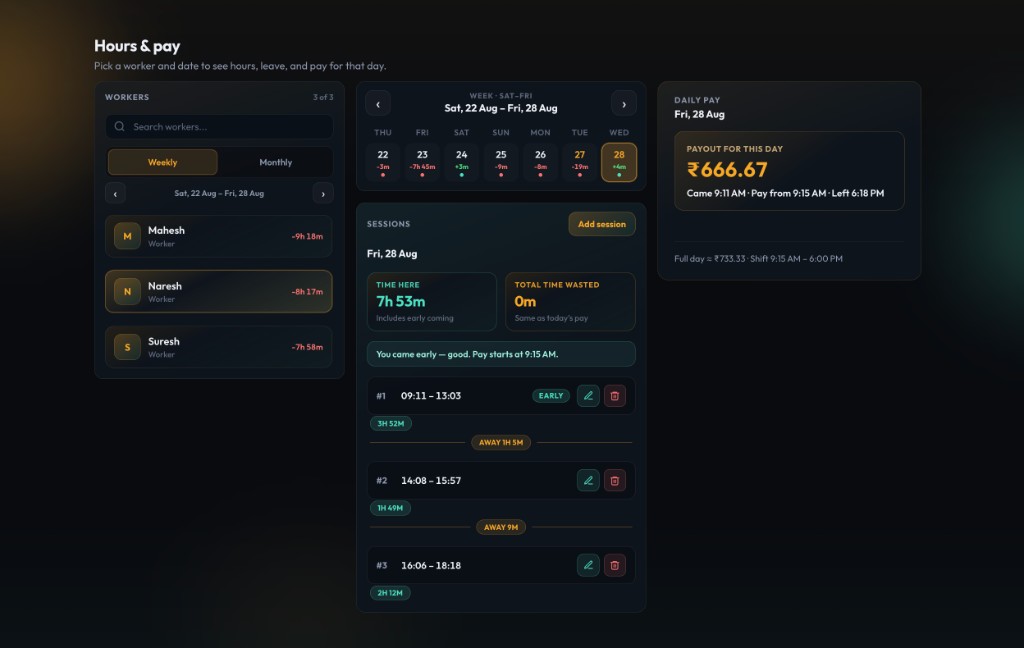
The problems above compound fast for any business running more than one location, or managing shift-based staff — exactly the shape of a workshop, garage, or small manufacturing unit.
A common real-world pattern: attendance for different branches gets tracked in separate WhatsApp groups, biometric machine exports get manually stitched together in Excel afterward, and by the time payroll runs, nobody’s fully sure which version of the sheet is current. One person becomes the sole keeper of a workbook with a dozen or more tabs — and when that person is unavailable, payroll simply waits.
For businesses with shift changes, lunch-break punches, or workers moving between job cards, Excel has no built-in way to validate any of it. Every exception has to be manually checked, which is exactly the kind of work that doesn’t scale as headcount grows.
What digital attendance actually fixes
Modern attendance systems close these gaps by removing the manual “trust layer” entirely:
- Attendance is captured at the source — biometric device, face recognition, or geo-tagged mobile check-in — rather than typed in after the fact
- Data flows directly into payroll, removing the manual reconciliation step where most errors creep in
- Anomalies surface automatically — a missed punch, an unusually short shift, a mismatch between hours and pay — instead of waiting for someone to notice during a manual audit
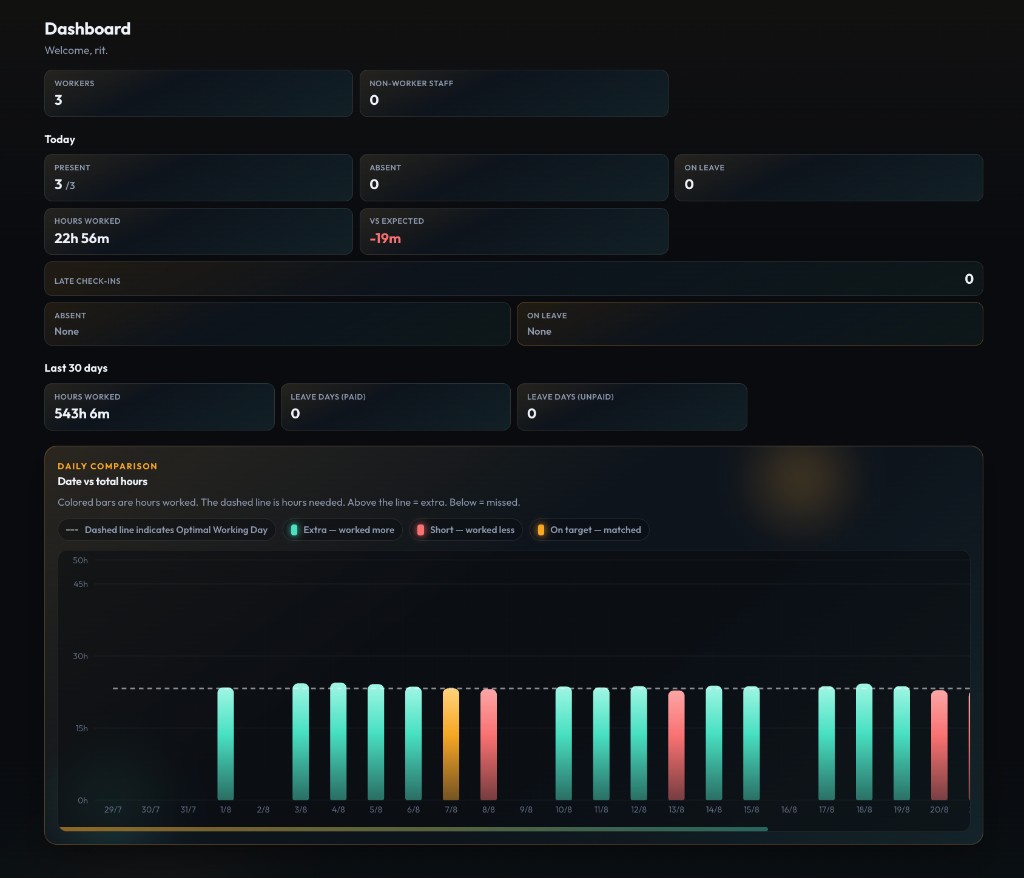
- Everyone can see the same record — owners get a full view across locations, and in the better tools, workers can check their own attendance and pay calculation too, which closes the trust gap from both directions
Businesses that make this switch commonly report saving 20–30 hours of HR time a month, alongside a sharp drop in payroll errors — some sources cite reductions of over 90% once biometric-backed attendance replaces manual entry.
The switch is already underway
This isn’t a hypothetical shift. A large and growing share of Indian SMEs above roughly 25–30 employees are actively moving off spreadsheets, largely because that’s the point where the hidden cost of “free” Excel starts to clearly exceed the cost of a proper tool. Below that size, a clean, disciplined spreadsheet can still work fine — but the moment multiple locations, shift complexity, or a larger workforce enter the picture, the math tips decisively toward digital attendance.
What to actually check before switching
Not every “digital attendance” tool solves the same problem equally well. A few things worth confirming before committing to one:
- Does it work with hardware you already own? Many businesses have already invested in a biometric machine — a good system should connect to it directly, not force a replacement.
- Is there a real dashboard for the owner, not just a phone app? Managing a multi-location team from a 6-inch screen doesn’t scale.
- Can workers verify their own attendance and pay? A system only the owner can see still leaves room for disputes — one both sides can check builds trust faster.
- Does it handle real shift patterns — lunch breaks, split shifts, overtime — or just a single in/out punch per day?
The bottom line
Excel isn’t a bad tool — it’s just the wrong tool for attendance and payroll once a business crosses a certain size or complexity. The cost of staying on it doesn’t show up as a bill; it shows up as HR hours, statutory penalties, and the slow erosion of trust between what a register says and what actually happened on the floor.
For businesses feeling that gap already, the numbers above suggest the switch usually pays for itself within a couple of quarters — not through a dramatic overhaul, but by removing the manual step where most of the cost was quietly hiding all along.