
For Small and Medium Enterprises (SMEs), tracking attendance by simply marking “Present,” “Absent,” or “Half-Day” is no longer enough. In modern workplace environments — ranging from factories and retail outlets to healthcare clinics and field service teams — work schedules are dynamic. Employees arrive early, log late punch-outs, take split meal breaks, or work irregular shifts.
Transitioning from coarse daily attendance tracking to minute-based attendance tracking is one of the most effective operational upgrades an SME can make to protect margins and build trust with its workforce.
1. What is minute-based attendance?
Minute-based attendance tracking logs the exact timestamp of an employee’s arrival and departure via biometric devices (fingerprint, facial recognition) or mobile geolocation apps. Instead of rounding working time up or down to the nearest half-day, payroll engines compute earnings down to the exact minutes worked.
- Traditional tracking: Arrive 40 minutes late → Marked as half-day loss or full present (inaccurate)
- Minute-based tracking: Arrive 40 minutes late → Pay calculated precisely for 7 hours 20 minutes (fair)
2. Key payroll benefits of minute-level accuracy
| Benefit | Impact on SMEs | Financial / operational outcome |
|---|---|---|
| Elimination of time leakage | 15-minute late arrivals across 20 employees add up to 100 hours of unworked paid time monthly. | Directly reduces inflated payroll expenses. |
| Fair overtime (OT) compensation | Workers who stay back 35 minutes to finish urgent tasks receive exact OT credit. | Increases employee trust and prevents wage disputes. |
| Seamless break & shift management | Differentiates active working time from unpaid lunch/tea breaks or split shifts. | Automates shift math without manual supervisor logs. |
3. Calculating minute-based pay: step-by-step
To convert exact minutes into monthly compensation without manual spreadsheets, follow this formula framework:
Step 1: Calculate minute rate. Convert the employee’s monthly rate into a minute-level rate based on standard working hours per month (e.g. 26 days × 8 hours = 208 hours = 12,480 minutes).
Minute rate = Monthly base gross salary ÷ Total expected standard minutes
Step 2: Aggregate net logged minutes.
Net working minutes = Total on-site minutes − Unpaid break minutes
Step 3: Compute final payout.
Gross earnings = (Net regular minutes × Minute rate) + (Overtime minutes × Minute rate × OT multiplier)
Automated attendance platforms calculate minute-level data instantly without manual error.
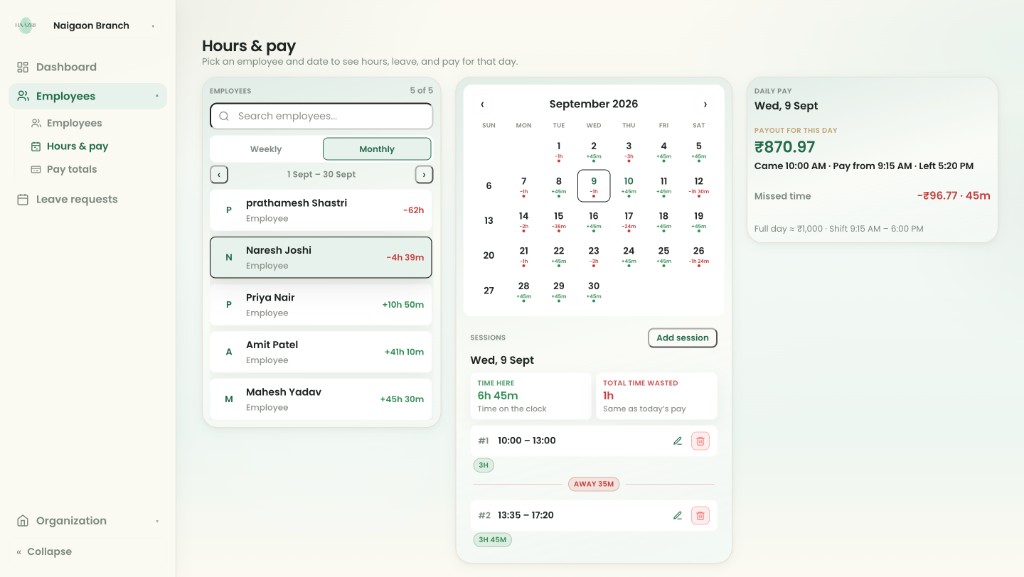
4. How automated software (like Haazri) simplifies minute-based payroll
Calculating minute-level attendance on paper or in Excel files quickly becomes an administrative nightmare. Automated attendance platforms like Haazri streamline this process entirely:
- Real-time biometric & mobile hardware sync: Punch timestamps from facial scanners, fingerprint machines, or PWA mobile logs are processed instantly down to the second.
- Configurable grace periods & thresholds: Set custom rules (e.g. a 10-minute arrival grace period before minute deductions kick in) to match your company policies.
- Worker self-service & verification: Employees can view their exact logged hours, breaks, and projected payout on their smartphone app daily, ensuring complete transparency and eliminating month-end payroll grievances.